History of Cornishware
3m
Written by Charlotte Rickards
the history of cornishware
It all started in 1864...
Early beginnings: 1864 to end of the 19th Century
The story of how Thomas Goodwin Green founded the first Cornishware factory in the late 19th Century is a rather charming one. It all begins with a tale of unrequited love. After Thomas faced a rejected proposal from Mary Tenniel (sister of the illustrator of ‘Alice in Wonderland’ John Tenniel), he took his broken heart out to Australia. In an attempt of self-betterment for her favour he built up a successful business as a builder. A little later, Mary indeed had a change of heart. When Thomas caught wind of such changed affections in a letter from his sister, he swiftly sold his business, returned to Britain, and the two were married in 1862. During their honeymoon in Scarborough, after a chance encounter they acquired a small yet charming craft pottery at Church Gresley – the very same church on the backstamp if you look under any of our wares. Thomas set to work. His Australian building skills proved invaluable; problems of the swampy ground were eradicated, and eventually later in 1871 he set up an entirely new factory adjacent to original site. Green possessed an exceedingly colourful and resourceful character, who was ‘much loved’ at the pottery, gaining the nickname ‘Swearing Tom’, Derek Stanley Green, Thomas’ great grandson, affectionately remembers. He was also an ambitious man. So, by the end of the 19th Century, Thomas had created a factory with model production that rivalled anything in Stoke-on-Trent, the pottery ‘capital’ of the UK. Yet despite all these great strides of modernisation, those at T.G. Green firmly believed that the traditional methods of manufacture were the best. T.G. Green’s teapots, pudding bowls and ‘nappies’ (a now old fashioned word for a cooking dish), sold like hot cakes. It became a staple item in the kitchens of families working in mining and textile industries from the Midlands and North of Britain. Yet interest was by no means restricted by location. The pottery begun a thriving export business, particularly to the colonial markets, notably Australia and New Zealand, and also to Europe.
Image belongs to T.G. Green Museum Archives (Dr Iain Hambling)
Banner Image belongs to T.G. Green Museum Archives (Dr Iain Hambling)
The Turn of the Century & the Origin of Cornishware
The Twentieth Century brought with it many changes for T. G. Green. The end of the First World War saw the virtual disappearance of paid cooks in British Kitchens and replaced by the bright-eyed “domestic-economy”, making decorative kitchenware all the more desirable. And so, despite increasing financial problems caused by the depression, the pottery made a profit every year. Then came the second sea-change. The dawn of the new century brought with it our famous Cornishware design, the iconic blue and white stripes. Much rumour swirls around its origins, namely that its inspiration was of the ‘blue of the Cornish skies and the white crests of the waves’ by T.G. Green’s south of England representative at the time. Equally mysterious is an exact date of origin for our mighty stripes, with only a few mere suggestions of its launch. Some recent detailed research by Dr Iain Hambling traces the original Cornishware design back to 1923 and credits Frederick Parker² who had joined the company as a General Manager in 1919. What we can confidently say is that by 1930s the range was well-established and much loved. Such romantic origins became a cornerstone to the brand’s identity with one typical advertisement relating the design to ‘Blue of the Atlantic – White of the Cornish clouds – Glisten of the Sea’ (A Cornish Ware leaflet, c.1938). Coupled with its glossy glaze and clean-cut finish by the turning process, Cornishware has proven have a lasting appeal for almost 100 years.
Image belongs to T.G. Green Museum Archives (Dr Iain Hambling)
Image belongs to T.G. Green Museum Archives (Dr Iain Hambling)
World War II and Towards the 1960s
Yet troubling times lay ahead for T. G. Green. The outbreak of war in 1939 brought difficulties as key employees were called up and the government imposed stringent controls on the ceramic industry. After the war when the restrictions were finally lifted, the pottery got back on its two feet and welcomed a period of recovery. With the advent of the 1950s brought with it the next generation of the Green family, represented by Derek Stanley. The colourful modernism of the age was also beautifully mirrored with the new ranges, notably the Patio shape, the chequered Gingham, and semi-abstract patterns. New ranges were introduced, and new visiting designers, Audrey Levy, former professor of RCA School of Fashion and Design, and Swedish designer, Berit Ternell, produced the popular designs such as Fleur, Roulette and Harlequin. This kaleidoscopic age of the was also reflected in new colours, namely Cornish Red, Cornish Gold and ‘Sunlit Yellow’.
Our 10oz Mug in the London Design Museum
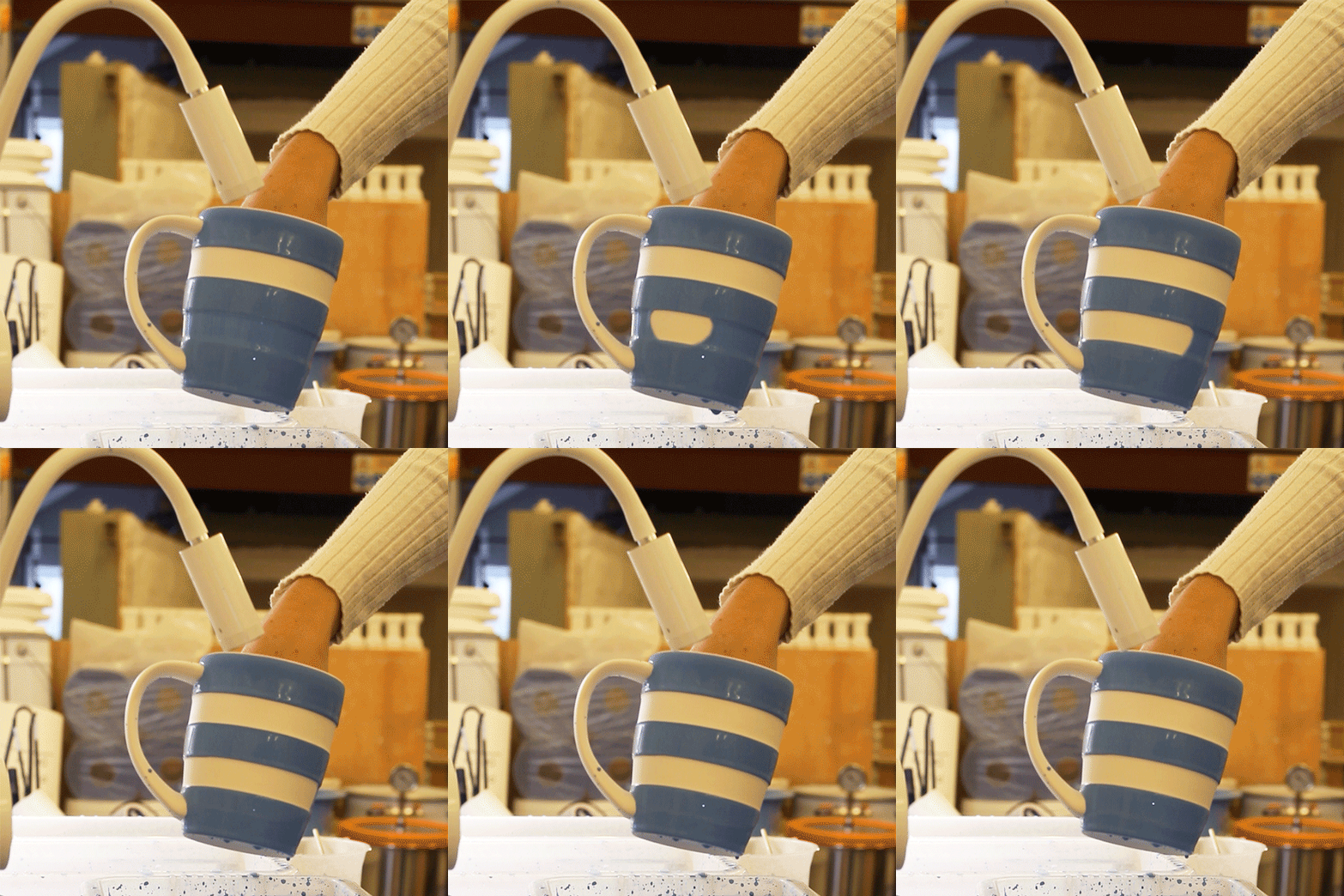
Dipping process in West Country pottery
Bankruptcy and Restoration
Towards the end of the 20th Century, a very difficult time for all UK ceramic manufacturers as competition from abroad increased, TG Green went through some challenging times and subsequent changes in ownership but new investment in the factory was in short supply and the business struggled. Sadly, in 2007 the business went into financial administration and the Church Gresley factory was closed down and production was halted and a moment of great sadness for all connected with the business. Yet, this was not the end of the story. From the ashes T.G. Green was bought by a trio of British investors Charles Rickards, Perry Haydn Taylor and Bill Barlow (all die hard Cornishware enthusiasts) in 2008. They recruited Paul Burston, TG Green’s Sales Director at the time of its demise and a crucial link to TG Green’s past heritage. Production joint ventures with other UK ceramic manufacturers were sought but at a time when most UK producers were moving some or all of their production abroad to fend off stiff pricing competition from low wage economies overseas. In 2009, reluctantly, the new team started production abroad in attempt to secure supply but remained committed to bringing production back to the UK.
Image belongs to T.G. Green Museum Archives (Dr Iain Hambling)
Image belongs to T.G. Green Museum Archives (Dr Iain Hambling)
Restoration
In the following years the relationships with key importers in Australia and New Zealand were reinvigorated and key customers such as John Lewis began reintroducing the brand back into their shops. New and old products were introduced and Cornish Red was launched aimed at a younger and more urban customer. Eight further new colours were introduced originally in the 12oz. mug and more recently to the iconic 10oz. In 2017 the production repatriation journey began using the original Cornish clay and glaze used since the 1920s and many of the time honoured manufacturing techniques. Flatware items, a generic term for mainly plates and bowls are decorated by hand and handled items are made using similar and highly dextrous skills with the additional process of applying wax relief to all the cream coloured areas before a hand dipping process is deployed.
Decorating in our West Country Pottery
Kiln stacking in our West Country Pottery
2020-2024
The first lockdown in 2020/21 brought significant challenges and, after a short period of closure, the pottery reopened after 10 days, running two shifts to facilitate social distancing guidelines. The future seemed very uncertain, with many retailers closing for an undefined period. However, increased activity on social media, led by Karina Rickards and Karina Fagras, drove online sales to new records, and the business struggled to keep up with demand throughout the Covid era as it doubled in size. In 2022, the business opened a new slip casting unit, producing all greenware items such as teapots and storage jars on site, which had previously been made by Royal Stafford in Stoke-on-Trent. Most of the products sold were made at the new site in the South West of England, where the business employed 27 highly talented and committed people, led by Charles Rickards and his daughter Rebecca. Charles and Rebecca Rickards also featured on It Runs In The Family podcast, where the story of Cornishware was shared in detail. —————————————- 1 Derek Stanley Green July 2001 ² Dr Iain Hambling-Wikipedia
Charles and Rebecca Rickards 2023
Royal Cornwall Show 2024
2024 - present
Since 2024, Cornishware has entered a significant new phase, strengthening both its heritage and its role within British ceramics. Following the collapse of Royal Stafford, the brand acted swiftly to secure its production future - acquiring machinery, taking on skilled staff, and re-establishing manufacturing in Stoke-on-Trent. This move not only safeguarded vital craftsmanship but also reinforced Cornishware’s commitment to UK-made production. The business has also grown considerably during this period and now employs over 60 people across its operations, reflecting both its expansion and continued investment in British manufacturing. Creatively, the brand has continued to evolve. Its iconic stripes now span an expanding range of colourways, while new, more versatile forms - such as the Family Dish - reflect modern ways of cooking and sharing. Collaborations with Harrods, Fortnum & Mason and Biscuiteers have further broadened its reach, introducing Cornishware to new audiences while staying true to its distinctive design heritage. Together, these developments mark a confident step forward - balancing tradition, innovation and collaboration as Cornishware continues to grow.
take a look around
harrods x cornishware
Watch the video Harrods filmed during their visit to Cornishware HQ and discover the craft and care behind the exclusive collection.
Cornishware collectors
Share your vintage Cornishware using the hashtag #VintageCornishware and we'll share it here.
@devon_creative
@t.g.green_museum
@t.g.green_museum
@t.g.green_museum